Clinical Psychologist and Psychoanalyst  ·  CRP 06/136189

A sensitive space for listening and the (re) construction of your history

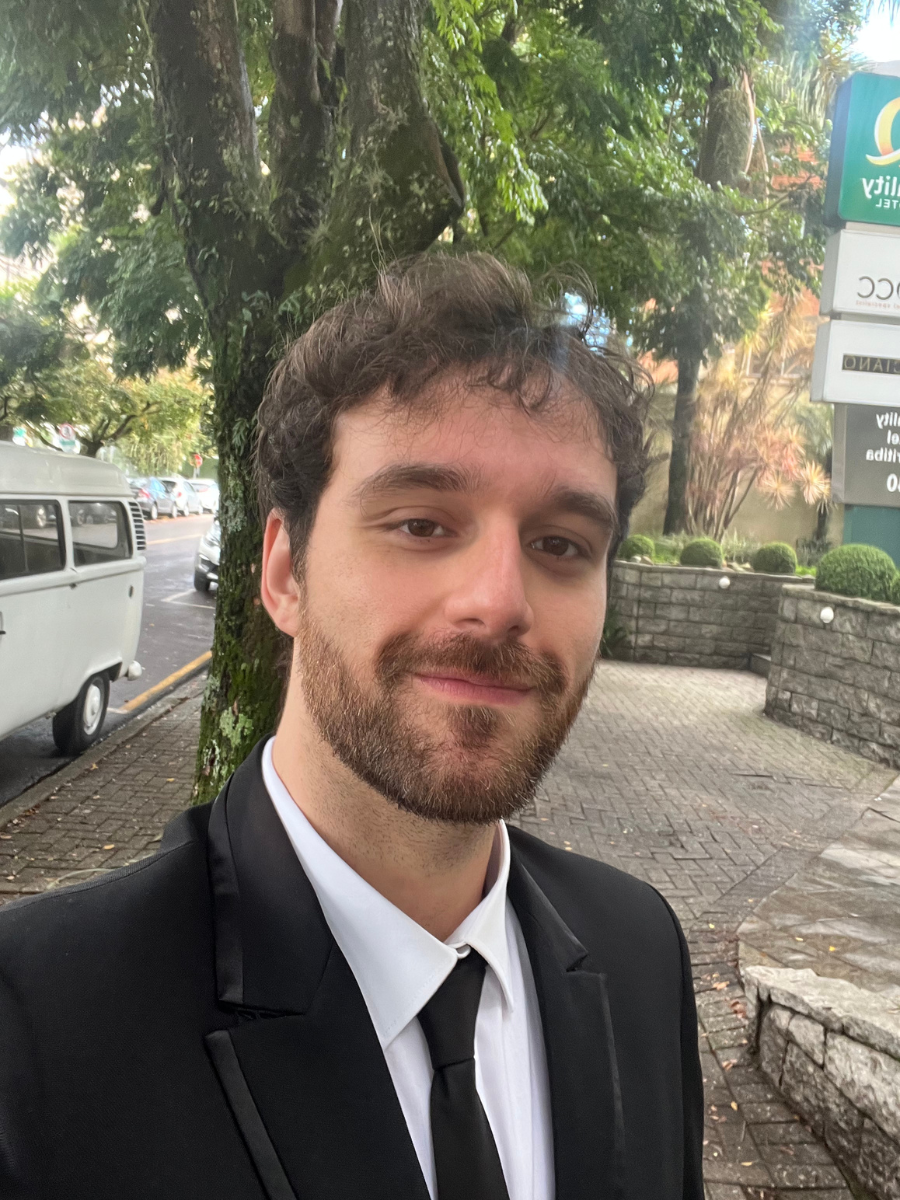
Lucas Vinícius Guimarães

Speaking about your malaise makes it possible to look at what has been lived and to produce new ways of being in the world. Analysis grounded in a solid clinical, theoretical and ethical foundation.

Lucas Vinícius Guimarães, clinical psychologist and psychoanalyst
Scroll to explore
01  The Psychoanalytic Clinic

Why speak about
what makes us suffer?

Analysis is a space in which you can speak freely about your suffering, without being judged for it and without the expectation of a ready-made model of how one should be and act.

Our lives are radically traversed by language: we are made of cuttings and fragments of what we have seen, heard and experienced in the world, and of the ceaseless attempt to translate all of this into words. Anguish and suffering appear as testimony to that experience: in whatever remains unintelligible, in what repeats itself without our knowing why, in an excess of meaning and in its complete absence, and in the different ways discourses affect and modify our body and our relation to others.

Analysis offers the possibility of coming face to face with what we ourselves have said. Out of the encounter — always a missed encounter — between speech and listening, new possibilities open up for desiring, loving, being and relating to the other.

“Analysis is a space for the (re) construction of oneself and of one's history, the actualization of the past in the present, in order to look at what has been lived from a new perspective, to question certainties and to face contradictions.”
02  Who It Is For

Who seeks analysis?

The treatment is suited to adolescents, adults and older people, whether in Brazil or abroad, who are going through moments of anguish, anxiety, transitions in personal or professional life, grief, difficult choices, questions of self-esteem and identity, stress, depression or melancholia, fears and phobias, difficulties in relationships and social interaction; who have been through trauma or physical and emotional violence; who have questions relating to sex and sexuality; who struggle with compulsions and addictions, or with any of the many other forms in which malaise presents itself in contemporary life.

Even so, beginning a process of analysis does not require a crisis, a psychiatric diagnosis or acute suffering: sometimes it is simply the wish to reflect on oneself, or to produce new ways of living and of relating to the other.

Each path through analysis is unique. The first step is simply to begin speaking.

On seeking help

We are constantly confronted with ideals of happiness, performance and productivity, and this often leads us to silence what we feel or to try to resolve things on our own. Seeking to begin a process of analysis is not a sign of weakness; it is an act of care and responsibility towards one's own life. This is a space for whatever rarely finds the possibility of being said and heard in our everyday relationships.

03  Services

Ways of working
and clinical support.

Adolescents and adults

Analysis and Psychotherapy

Individual, ongoing clinical work devoted to listening to suffering and to accompanying each person in the elaboration of their own history.

Psychologists and psychoanalysts

Supervision in Psychoanalysis

A space of study and listening for colleagues who wish to reflect on cases from their own practice, strengthening the conduct, the technique and the ethics of analytic work.

Bonds and family

Couples Therapy and Parental Guidance

Support for couples seeking to find their way back to dialogue, and for mothers and fathers facing the challenges of raising children, widening the space for listening within relationships.

04  Professional Background

A training built
with rigor and continuity.

Degree
Psychology — UNIFESP
Degree in Psychology from the Federal University of São Paulo (UNIFESP).
Specialization
Childhood Psychology and Health — UNIFESP
Specialist qualification from the Escola Paulista de Medicina (EPM / UNIFESP).
Clinical Training
Forum of the Lacanian Field
Participant in the clinical training programs of Lacanian-oriented psychoanalysis.
Continuing Education
Clinical study groups
Ongoing participation in study groups devoted to refining clinical work.
05  Reviews

What patients
say.

★★★★★
5,0 / 5
11 reviews on Google
A
Ana Jéssica Cruz Teixeira
★★★★★

A professional with attentive listening, solid theoretical grounding and an ethical commitment to the analytic process. His clinical stance reflects his sense of responsibility and a genuine care for each patient's path. He is also a colleague who contributes to the field, whether through theoretical exchange or by building spaces that value psychoanalytic listening.

M
Maytê Amorim
★★★★★

For anyone looking for a professional to begin analysis, Lucas is an excellent therapist, and one who is constantly training. I recommend him without hesitation!

M
Mauro Reis
★★★★★

Lucas is a serious professional, committed to rigorous training. I recommend him to anyone looking for an analyst they can trust

T
Thais Marques
★★★★★

Great psychologist! He has experience and a specialization from the Federal University of São Paulo! I recommend him! Pleasant place for sessions

F
fausi kalaoum
★★★★★

Excellent professional. Highly qualified, and the space is very comfortable.

I
Isabela Boitar
★★★★★

Great psychologist! I highly recommend him!

C
Clarice Lopes
★★★★★

An attentive and dedicated professional.

Public reviews verified on Google · originally written in Portuguese
06  Cultural Space

Where psychoanalysis
meets culture.

Art often transmits something that has not yet been able to be said or named.

“

Poets and novelists are precious allies (...) for they know, between heaven and earth, a great many things our academic wisdom does not yet dream of. In the knowledge of the soul, they are our masters...

Sigmund Freud
Cover of Le Rayon vert (Éric Rohmer, 1986)
Movie

Le Rayon vert (Éric Rohmer, 1986)

“The Green Ray” is a 1986 French film directed by Éric Rohmer which follows Delphine, a withdrawn young woman who, after a romantic disappointment, faces the distressing prospect of spending the summer holidays alone. Through the protagonist's gaze, the film addresses themes such as depression, loneliness and the longing to connect with another.
Cover of In the Heat of the Sun (Jiang Wen, 1994)
Movie

In the Heat of the Sun (Jiang Wen, 1994)

“In the Heat of the Sun” is a 1994 Chinese film directed by Jiang Wen which portrays the coming of age of a group of young people during the country's Cultural Revolution, through an intimate look at questions of belonging, the discovery of sexuality and the challenges of adolescence. The film is narrated by its protagonist, Ma Xiaojun, and in its very construction it addresses the theme of memory and of the narrative of a life, which is not always linear or reliable.
Cover of Paprika (Satoshi Kon, 2006)
Movie

Paprika (Satoshi Kon, 2006)

“Paprika” is a Japanese animated film directed by Satoshi Kon and released in 2006. Starting from a technology that allows therapists to enter their patients' dreams, the film addresses questions such as trauma, technological advances and the limits between reality and dream.
Cover of Persona (Ingmar Bergman, 1966)
Movie

Persona (Ingmar Bergman, 1966)

“Persona” is a 1966 Swedish film written and directed by Ingmar Bergman. When a successful stage actress suffers an emotional breakdown and stops speaking, a nurse is assigned to care for her in an isolated house. The relationship between the two characters brings to the surface questions of identity, isolation and femininity.
Cover of The Tartar Steppe (Dino Buzzati, 1940)
Book

The Tartar Steppe (Dino Buzzati, 1940)

“The Tartar Steppe” is a novel by the Italian writer Dino Buzzati, published in 1940. The story follows the path of a young lieutenant who is posted to a remote outpost. The book addresses questions such as the passing of time, expectation and inhibition.
Cover of Giovanni's Room (James Baldwin, 1956)
Book

Giovanni's Room (James Baldwin, 1956)

“Giovanni's Room” is an American novel written by James Baldwin in 1956. The book deals with the encounter and the relationship between two young men in the city of Paris. It addresses questions such as sexuality, masculinity and prejudice.
Cover of The City & the City (China Miéville, 2009)
Book

The City & the City (China Miéville, 2009)

“The City & the City” is a work of science fiction written by the British author China Miéville in 2009. The story begins with a wide-ranging murder investigation across two cities that exist simultaneously in the same space, each of whose citizens are forbidden to enter or even to acknowledge the other city. The book addresses questions such as social invisibility, cultural difference and politics.
Cover of The Love of Singular Men (Victor Heringer, 2016)
Book

The Love of Singular Men (Victor Heringer, 2016)

“The Love of Singular Men” is a novel by the Brazilian author Victor Heringer, published in 2016. The story is narrated by Camilo, who recalls his youth in Rio de Janeiro. The book addresses questions such as the awakening of sexuality, violence and trauma.
Cover of WHAT DOES ONE WANT?
Article

WHAT DOES ONE WANT?

The question “what do I want?” is often confused with “what does the other want from me?”, given that we are constantly bombarded with familial and cultural imperatives about what we ought to be or what we should want for ourselves. Is this really what I desire? Is it possible to desire beyond what the other expects of me? And after all, what is it that the other expects of me? Indeed, is there really any other expecting anything of me at all? These and other questions arise when we are confronted with the question of desire, and in the tireless attempt to formulate an answer we come up against the traps — but also the many possibilities — offered by language. Through speech, and through listening to what is being said, it becomes possible to identify the ideals that haunt the one who speaks and which, being themselves constructed in the field of language — out of what was heard, seen and taken in from the speech of another — cause suffering and paralysis in the capacity to desire. Analysis makes room for the exercise of speech and, therefore, for the opportunity to say oneself in ways other than those that were said to us by others throughout our lives.
Cover of THE MISSING WORD
Article

THE MISSING WORD

It is common to come up against the difficulty of saying exactly what we are thinking and of conveying with precision what we are feeling. In everyday relationships with family, friends and colleagues, and in love relationships, we sometimes feel misunderstood. Failures in communication cause us suffering and make us question what we say and whether the other is in fact listening to us. Words are missing — or the words, however abundant, fail to signify the totality of what we wish to say. In speaking we are constantly confronted with the impossibility of saying everything and, more than that, we are surprised by what is produced out of the very failure of our speech. Analysis is a space that welcomes what is strange to us in ourselves, making possible the production of a knowledge about oneself through the slips and stumbles of discourse.
Online Sessions

Therapy from wherever
you are.

At present, all sessions take place 100% online, by video call. It is a format that preserves the full depth of clinical work with the convenience of not having to travel — all you need is a private room and a good connection.

International Sessions

Online sessions for patients anywhere in the world, in English or Portuguese, scheduled around your time zone.

Guaranteed confidentiality

The same ethical commitment and confidentiality as an in-person consulting room.

A secure setting

Trusted platforms and a protected space in which you can speak with ease.

Flexibility

Times that fit your routine, from anywhere in Brazil or the world.

07  Frequently Asked Questions

Questions that
often come up.

The first session is a welcoming encounter. It is a moment for you to speak about what has brought you here and for us to get to know one another. There is no script: we talk about your questions and about how the work might unfold. It is also an opportunity to sense whether there is the rapport needed for us to continue together.
Sessions are of variable duration and take place weekly.
Sessions are private practice only. This choice preserves the freedom and the confidentiality of the analytic process, without interference or limits imposed by third parties. If needed, a receipt can be issued for reimbursement through your health plan or for income tax deduction in Brazil.
Yes. Online work follows the same ethical rigor and confidentiality as in-person work, in accordance with the regulations of the Brazilian Federal Council of Psychology (CFP). Sessions take place by video call on secure platforms. All that is asked is that you be in a private setting where you can speak freely and undisturbed.